ShinyHunters Claims FBI Data Breach, Alleges Access to Agents and Job Applicants
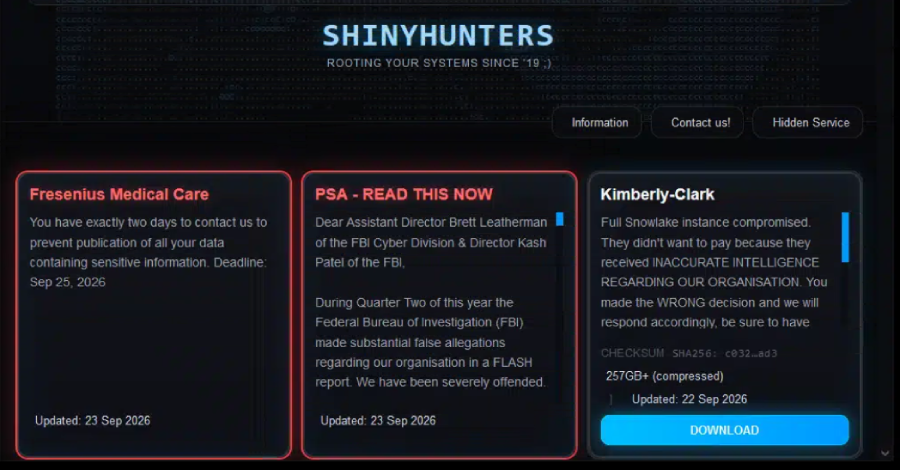
ShinyHunters claims to have stolen data on nearly all FBI agents and job applicants.
On September 22, 2026, the cyber‑extortion outfit known as ShinyHunters posted a bold statement on its dark‑web leak site asserting that it had breached the United States Federal Bureau of Investigation (FBI). The group claims to have stolen “very sensitive data on almost ALL FBI agents and individuals who filed an application with the FBI for a job.” The allegation, published without independent verification, marks the latest in a series of high‑profile claims by criminal collectives targeting government agencies.
#What Happened
ShinyHunters’ announcement appeared as a terse paragraph on its leak platform, accompanied by a downloadable archive that the group says contains the stolen files. The statement reads:
"We have compromised the FBI and hold very sensitive data on almost ALL FBI Agents and individuals who filed an application with the FBI for a job."
The group did not disclose how it accessed the data, what specific systems were involved, or any technical details such as IP addresses, malware families, or exploited vulnerabilities. No official comment from the FBI was released at the time of writing, and no third‑party security firm has independently corroborated the breach.
#Scope of the Alleged Data
According to ShinyHunters, the exfiltrated material includes:
| Data Category | Description | Potential Impact |
|---|---|---|
| Agent personnel files | Names, badge numbers, clearance levels, assignment histories | Targeted blackmail, identity theft, operational compromise |
| HR recruitment records | Resumes, background‑check results, interview notes for job applicants | Social engineering, credential harvesting |
| Internal communications | Emails, chat logs, internal memos | Insight into investigative priorities, strategic planning |
| Security clearance documentation | Polygraph results, investigative reports | Direct threat to classified operations |
The table reflects the categories ShinyHunters says it possesses; the actual contents remain unverified.
#Why This Matters
If the claim proves accurate, the breach would represent a severe compromise of the FBI’s internal security posture. Access to personnel files could enable adversaries to:
- Conduct targeted phishing or spear‑phishing campaigns against agents, leveraging personal details to increase success rates.
- Blackmail current or former agents, potentially coercing them into divulging classified information.
- Exploit recruitment data to impersonate job applicants, gaining footholds in future hiring pipelines.
Beyond the immediate operational risks, the incident could erode public confidence in the FBI’s ability to safeguard its own workforce, a cornerstone of national security.
#Known vs. Uncertain Elements
What is confirmed:
- ShinyHunters posted a claim on its leak site on September 22, 2026.
- The claim explicitly mentions data on “almost ALL FBI agents” and job applicants.
What remains uncertain:
- Whether any data was actually exfiltrated or if the claim is a bluff designed to extract ransom.
- The attack vector: no information on exploited vulnerabilities, compromised endpoints, or lateral movement tactics.
- The scale of the breach: the phrase “almost ALL” is vague and could be hyperbole.
- The FBI’s internal response: no official statement or mitigation steps have been disclosed.
#Potential Motivations
ShinyHunters has a history of publishing data dumps after receiving ransom payments. By announcing a breach of a high‑profile agency, the group may be attempting to:
- Pressure the FBI into paying a large ransom – the FBI’s budget and public accountability make it a lucrative target for extortion.
- Boost the group’s reputation – claiming a breach of a premier law‑enforcement agency can attract new customers for future extortion services.
- Test defensive measures – publicizing the claim forces the FBI to reveal its incident‑response capabilities, which can be studied for future attacks.
#Immediate Recommendations for the FBI and Partners
While the FBI has not confirmed the breach, standard best practices for a suspected insider‑or‑external compromise apply. Security teams should consider the following checklist, which can be executed via common command‑line tools:
# 1. Identify anomalous logins to privileged accounts
grep -i "admin" /var/log/auth.log | awk '{print $1,$2,$3,$9,$11}'

# 2. Search for large outbound data transfers (e.g., >100 MB) in the last 24h
awk '$10 > 104857600 {print $0}' /var/log/ufw.log

# 3. Verify integrity of critical HR and personnel files using SHA256 hashes
sha256sum /srv/fbi/hr/*.pdf /srv/fbi/personnel/*.docx > /tmp/current_hashes.txt
# Compare with known good hashes stored offline
diff /tmp/current_hashes.txt /opt/secure/hashes/known_good.txt

# 4. Isolate any endpoint showing signs of data exfiltration
iptables -A INPUT -s <suspicious_ip> -j DROP
These commands are illustrative; a full incident‑response plan would involve forensic imaging, threat‑intel correlation, and coordination with the Department of Justice.
#What Could Happen Next?
- Official Confirmation or Denial: The FBI may issue a statement within days, either confirming a breach and outlining mitigation steps or denying the claim outright.
- Ransom Negotiations: If the claim is genuine, ShinyHunters could open a negotiation channel, demanding payment in cryptocurrency. Law‑enforcement agencies typically avoid paying ransoms, but the decision may hinge on the sensitivity of the data.
- Public Disclosure of Data: Should negotiations fail, the group may release portions of the alleged data dump, potentially exposing personal information of agents and applicants.
- Policy Reassessment: A confirmed breach would likely trigger a review of the FBI’s internal network segmentation, privileged‑access management, and recruitment‑process security.
#The Bigger Picture
ShinyHunters is not the first criminal group to target U.S. federal agencies. Over the past decade, ransomware gangs have repeatedly claimed access to Department of Defense, State Department, and even the Department of Health and Human Services networks. Each claim forces agencies to balance transparency with operational security. The FBI’s response will be watched closely by other government bodies, private‑sector security teams, and the broader cyber‑crime ecosystem.
#What to Watch
- Official FBI Statements: Look for press releases or briefings from the FBI’s Cyber Division within the next 48‑72 hours.
- Data Leak Sites: Monitor known breach‑leak platforms for any uploaded archives that match ShinyHunters’ description.
- Cryptocurrency Payments: Track blockchain analytics for large transfers to wallets associated with ShinyHunters, a potential indicator of ransom activity.
- Legislative Reactions: Lawmakers may call for hearings on federal cybersecurity funding and oversight in response to a high‑profile breach claim.
#Conclusion
ShinyHunters’ allegation of an FBI breach raises alarm bells, but the lack of independent verification leaves many questions unanswered. Whether the claim is a genuine disclosure of a massive security failure or a strategic bluff, the incident underscores the persistent threat that organized cyber‑extortion groups pose to even the most guarded institutions. Vigilant monitoring, rapid incident response, and transparent communication will be essential to mitigate any real damage and to preserve confidence in the nation’s premier law‑enforcement agency.
#Why This Matters
The FBI’s ability to protect its own personnel data is a linchpin of national security. A breach that exposes agent identities, clearance levels, or recruitment records could enable adversaries to conduct targeted espionage, blackmail, or sabotage. Even the perception of vulnerability can erode trust among partners, hamper recruitment, and embolden other threat actors. Stakeholders—from federal agencies to private contractors—must stay alert, verify the claim’s authenticity, and prepare for potential fallout.