TeleBotHost
HomeBlogAbout

Our products

TeleBotHostOfficialHost Telegram bots without babysitting servers.teledevs.meOfficialWhere we keep our developer tools and product links.
HomeBlogAbout

Our products

TeleBotHostOfficialHost Telegram bots without babysitting servers.teledevs.meOfficialWhere we keep our developer tools and product links.
‌
‌
‌
‌
‌
‌
‌
‌
‌
‌
‌
‌
‌
‌
‌
‌
‌
‌
‌
‌
‌
‌
‌
‌
‌
‌
‌
‌
‌
‌
‌
‌
‌
‌
TeleBotHost

Clear writing on tech, travel, food, work, and the rest of ordinary life.

Explore

HomeBlogAboutRSS

Topics

FinanceSecurityTelegram

Products

TeleBotHostteledevs.me

© 2026 TeleBotHost. All rights reserved.

Built for readers who like it clear.

Blog›Security›CISA Flags Three Actively Exploited Vulnerabilities in JFrog Artifactory and ConnectWise ScreenConnect, Urges Immediate Remediation
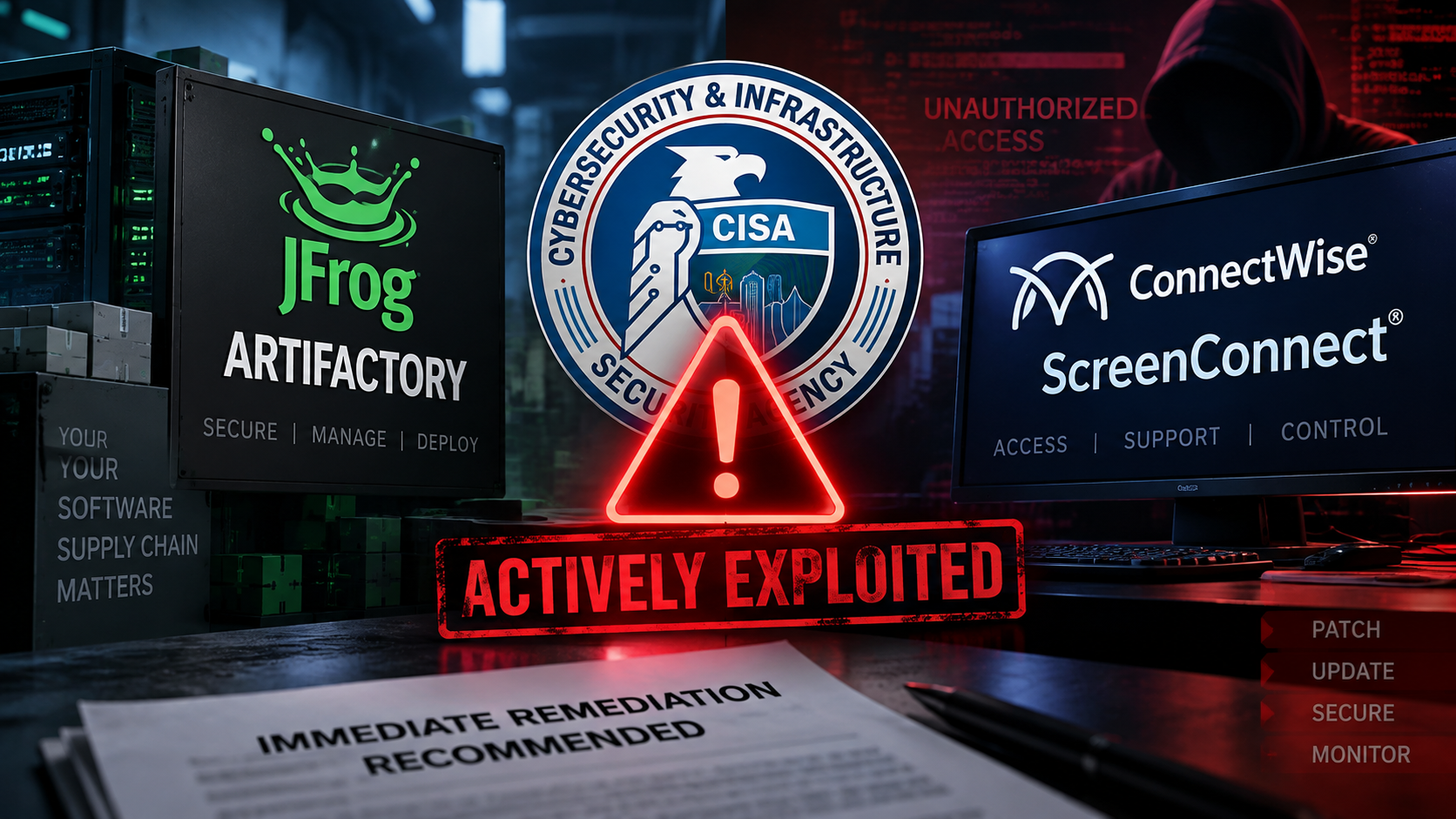
CISA Flags Three Actively Exploited Vulnerabilities in JFrog Artifactory and ConnectWise ScreenConnect, Urges Immediate Remediation

TTTeleBotHost Team·September 12, 2026·4 min read
A digital padlock icon superimposed over a network diagram or server rack, with flashing warning lights, symbolizing cybersecurity alerts and immediate action against threats.
Security Warning

Active Exploitation Confirmed: The Cybersecurity and Infrastructure Security Agency (CISA) has confirmed in-the-wild exploitation of three critical security flaws across JFrog Artifactory and ConnectWise ScreenConnect. Unpatched instances are actively targeted for full administrative takeover.

On September 11, 2026, CISA officially released an urgent security advisory adding three high-impact vulnerabilities to its Known Exploited Vulnerabilities (KEV) Catalog. These flaws affect widely deployed DevOps infrastructure and remote management tooling: JFrog Artifactory, the enterprise artifact repository and container registry, and ConnectWise ScreenConnect, the ubiquitous remote support and endpoint access platform.

The additions trigger binding compliance requirements for U.S. federal civilian agencies and serve as an urgent warning for global enterprise IT teams to patch immediately and conduct forensic compromise assessments.


#Vulnerability Breakdown & Matrix

The newly listed flaws represent fundamental failures in access control, identity validation, and privilege boundaries. Attackers exploiting these weaknesses can bypass access controls, hijack user sessions, and gain root or administrator level control over the affected asset.

Vulnerability IdentifierAffected SoftwareVulnerability TypeImpact / Exploitation VectorCISA Catalog Status
CVE-2026-42016JFrog ArtifactoryIncorrect AuthorizationUnauthorized access to internal artifact repositories, code packages, and buildsActive Exploitation Added Sept 11, 2026
CVE-2026-42018JFrog Artifactory
Views0 views
PublishedSeptember 12, 2026
Last updatedSeptember 12, 2026

Related posts

  • Close-up of a hand navigating a complex digital interface with code and data visualizations, symbolizing the intricate process of cybersecurity analysis.Beyond the Scanner: Why Your 'Critical' Vulnerabilities Aren't Always Your Biggest Risk2026-09-11
  • OpenAI Targets Wall Street Junior Bankers with ChatGPT for Financial ServicesOpenAI Targets Wall Street Junior Bankers with ChatGPT for Financial Services2026-09-11

Share post

X (Twitter)FacebookWhatsAppTelegram

Post info

Author
TeleBotHost Team
Views
0 views
Published
September 12, 2026
Updated
September 12, 2026
Read time
4 min read

Share post

X (Twitter)FacebookWhatsAppTelegram

Related posts

  • Close-up of a hand navigating a complex digital interface with code and data visualizations, symbolizing the intricate process of cybersecurity analysis.Beyond the Scanner: Why Your 'Critical' Vulnerabilities Aren't Always Your Biggest Risk2026-09-11
  • OpenAI Targets Wall Street Junior Bankers with ChatGPT for Financial ServicesOpenAI Targets Wall Street Junior Bankers with ChatGPT for Financial Services2026-09-11
Improper Authentication
Session forgery and authentication bypass leading to arbitrary action execution
Active Exploitation Added Sept 11, 2026
CVE-2026-84869ConnectWise ScreenConnectImproper Privilege Management & Missing AuthorizationPrivilege escalation granting unauthenticated or low-privilege actors full remote endpoint controlActive Exploitation Added Sept 11, 2026

#The Threat Landscape: Why DevOps & Remote Access Tools Are Targeted

Modern cyber adversaries prioritize software supply chains and remote desktop solutions because they offer immense blast radius:

  1. Supply Chain Poisoning via JFrog Artifactory: Artifactory sits at the center of CI/CD pipelines, storing proprietary binaries, Docker images, npm packages, and deployment artifacts. By exploiting CVE-2026-42016 and CVE-2026-42018, adversaries can tamper with production packages, plant backdoors into software builds, or steal confidential source materials.
  2. Immediate Lateral Movement via ConnectWise ScreenConnect: ScreenConnect instances maintain high-privilege agents across thousands of client workstations and servers. Flaws like CVE-2026-84869 enable threat actors to deploy ransomware, exfiltrate data, or establish persistent footholds without triggering typical endpoint alarms.
Important Notice

Federal Mandate Under BOD 26-04: CISA’s Binding Operational Directive (BOD) 26-04: Prioritizing Security Updates Based on Risk legally mandates that Federal Civilian Executive Branch (FCEB) agencies prioritize vulnerabilities listed in the KEV Catalog on internet-facing assets that grant total control post-exploitation.

Crucially, BOD 26-04 establishes a mandatory requirement for agencies to check whether adversaries compromised the system prior to patch deployment.


#Action Plan & Remediation Guide

Enterprise security and DevOps teams should execute the following protocol immediately:

bash
# Incident Response & Remediation Checklist:
1. Identify all internet-exposed JFrog Artifactory and ConnectWise ScreenConnect instances.
2. Upgrade JFrog Artifactory to the latest vendor release patching CVE-2026-42016 and CVE-2026-42018.
3. Apply ConnectWise ScreenConnect security patches addressing CVE-2026-84869 immediately.
4. Inspect web application firewall (WAF) and reverse proxy logs for anomalous POST/GET requests.
5. Review access tokens, API keys, and service account credentials stored in Artifactory.
Tip & Recommendation

Forensic Audit Recommendation: Because threat actors frequently apply persistence mechanisms prior to public patch availability, review access logs for unexpected administrative accounts created in ScreenConnect or abnormal package downloads from Artifactory over the past 30 days.


#Primary Sources & Official References

  • CISA Advisory (Sept 11, 2026): CISA Adds Three Known Exploited Vulnerabilities to Catalog
  • National Vulnerability Database: CVE-2026-42016 | CVE-2026-42018 | CVE-2026-84869
  • CISA Catalog: Official Known Exploited Vulnerabilities (KEV) Catalog
  • Federal Policy: Binding Operational Directive (BOD) 26-04

#Why This Matters

These new additions to CISA's Known Exploited Vulnerabilities Catalog confirm that cybercriminal and state-sponsored groups are actively weaponizing vulnerabilities in core enterprise tools. For federal agencies, immediate mitigation is required under federal law; for private sector enterprises, failing to patch leaves production software supply chains and remote access infrastructure completely exposed to hostile takeover. Organizations must treat these updates as emergency priority deployments.